 Blaster swap
Blaster swap fees: Historical Charges and Output Shortfalls
updated
Blaster swap fees included pool charges that affected the exchange calculation, while network costs required separate accounting. A received amount below an earlier quote didn't establish an extra fee. Explaining that difference requires matching the recorded trade to its pool version, input amount and original output estimate.
The short version: A historical swap's output shortfall can reflect trading conditions, while separately recorded network charges explain another part of its cost.
Costs in the Quote, Pool and Wallet Record
A quote, a pool exchange and a wallet debit describe different parts of the same transaction. The quote estimates the output under particular trading conditions. Pool charges affect the exchange calculation. Network charges pay for transaction processing, so they belong beside the trading result when calculating the total expense.
Start with the particular difference that needs explaining. Fewer output tokens require a comparison with the accepted quote and actual exchange terms. A larger reduction in the paying wallet requires an accounting of transfers and network charges. Combining these questions too early can turn the same expense into two apparent deductions.
Compatible Records Before Any Fee Comparison
A cost comparison requires matching token identities, amounts and execution methods. Similar labels don't establish that two records describe the same exchange.
Matching the Input and Output
Identify each asset by its network and, for contract tokens, its contract address. Distinguish native ETH from wrapped ETH when matching wallet transfers to pool records. The output must also belong to the intended recipient. A displayed balance for another token, another network or another account can't establish an excessive fee. Compare quantities in their token units before interpreting a difference in the wallet's currency valuation.
Matching the Exchange Method
Blaster's V3 router exposed both exact-input and exact-output methods. The former specified an input amount and minimum output; the latter specified an output amount and maximum input. Those limits had different meanings. The swap's maximum input wasn't necessarily the amount spent, and a minimum output wasn't the original quote.
Keep these distinctions in the comparison. Otherwise, an unused spending limit can look like a refund that went missing, or an output floor can look like a promised exchange rate.
Is Missing Output Always an Additional Fee?
Missing output relative to a quote can reflect price movement or a mismatched comparison rather than an additional charge. Price impact describes the effect of the trade itself on the pool's price. Slippage describes the difference between expected and executed pricing. Neither term identifies a separate payment to a fee recipient.
An executable quote may already incorporate the trade's price impact and pool charge. Adding both again to the gap between that quote and delivered output would exaggerate the cost. A displayed reference price creates a different comparison because it may describe the market before the proposed trade.
Slippage tolerance is a permitted execution deviation, not a fee percentage. Raising that tolerance doesn't reduce the pool charge or explain an old transaction's expense.
Pool Versions Changed the Applicable Fee Calculation
The published V2 pair code applied a swap fee equivalent to 0.3% of the input amount received by the pool. That figure describes this implementation's pool charge, not every cost associated with a Blaster exchange.
A historical receipt must match that implementation before the figure can explain its cost. The fee stayed within the pool accounting rather than requiring a separate transfer labelled as a trading fee. An explorer's transfer list therefore needn't show a distinct fee payment for the charge to exist.
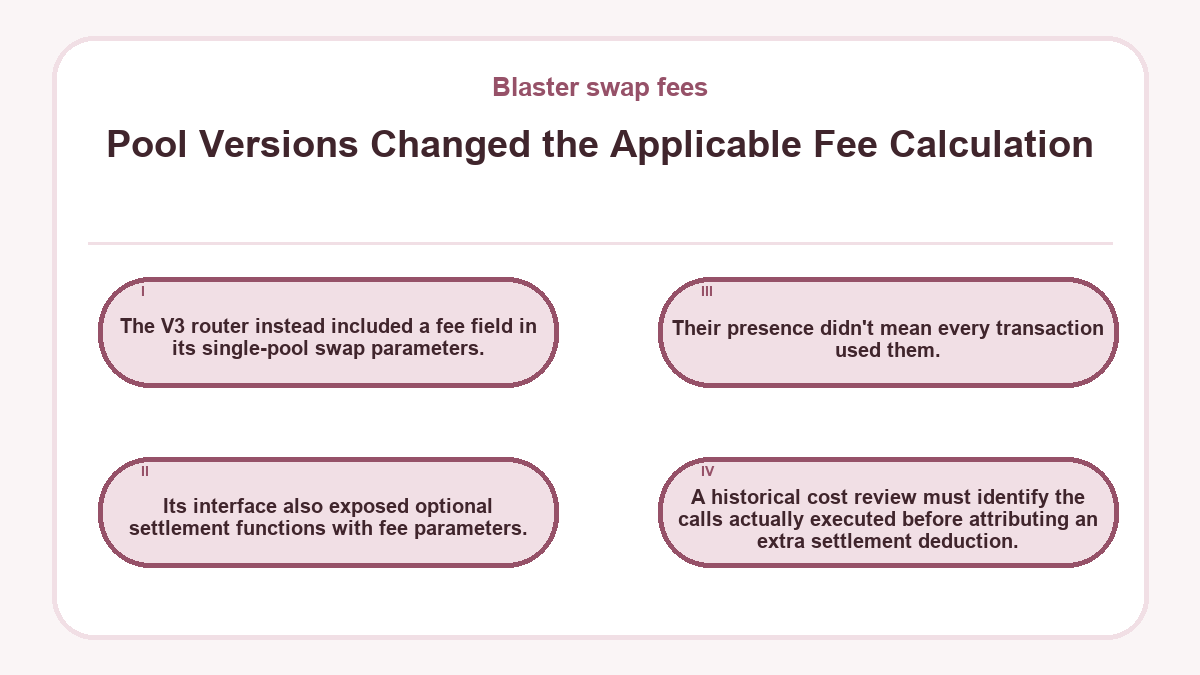
The V3 router instead included a fee field in its single-pool swap parameters. Its interface also exposed optional settlement functions with fee parameters. Their presence didn't mean every transaction used them. A historical cost review must identify the calls actually executed before attributing an extra settlement deduction.
Can a Swap Charge Gas Without Delivering Tokens?
A transaction that reverted after inclusion could consume gas without completing its token exchange.
Execution That Reverted
A reverted transaction rolls back its state changes, while the sender pays for the computation performed. Its network cost can therefore explain a wallet debit even when the exchange delivered nothing. The fee estimate shown before submission isn't the final charge; the completed receipt supplies the actual usage information.
Approval That Succeeded Separately
A separately submitted token approval has its own transaction record. Its network charge remains part of the attempted exchange's expense even if the later swap fails. Keep the approval amount separate from this expense: spending permission describes authorization, not a payment of that entire token amount.
A cost total for one successful swap and a cost total for several attempts answer different questions. State which total you're calculating before comparing them.
Network Charges Beyond the Pool Fee
Blast's documented transaction-cost structure included L1 data availability charges alongside L2 base and priority fees. A calculation that includes only execution gas can therefore miss part of the network expense. Use the receipt's applicable fee components without adding a component again when an explorer already includes it in the displayed total.
The same documentation described gas revenue that eligible contracts could claim. That mechanism didn't establish a refund to every trader. A rebate belongs in a personal cost calculation only when a payment or credit can be tied to that transaction and recipient.
How Should Costs in Different Tokens Be Compared?
Costs in different tokens require a common valuation basis before their amounts can be added. Preserve the original token quantities alongside any converted total.
For a historical comparison, use a consistent valuation time. Valuing the input at execution and the output at today's price mixes trading expense with later market movement. The same problem arises when an old network charge receives a new currency valuation while the token exchange retains its original valuation.
A net-output comparison also needs consistent treatment of included charges. If the quoted output already reflected the pool fee, subtracting that fee again understates the quote. Separately paid network costs still belong in the overall expense, expressed in the same comparison unit.
The Shutdown Limited the Meaning of Old Quotes
Blaster announced that it would cease operations and set January 15, 2025 as the frontend deadline for position withdrawals. That withdrawal window didn't establish continuing access to new swap quotes. Historical exchange records remain useful for explaining past charges, but an old screen doesn't demonstrate present execution availability.
A Like-for-Like Review of a Lower Received Amount
Consider a historical exchange whose recorded output is lower than the saved estimate. First match the token identities and execution method. For an exact-input swap, compare output at the same input quantity. For an exact-output swap, match the requested output and compare the estimated input with the amount actually spent. Reconcile the existing trade; submitting another exchange would incur another cost without repairing the historical record.
- If the token contracts or network differ, stop the fee calculation and identify the matching records.
- If an exact-input quote and the executed swap use different input amounts, resolve that mismatch before calculating an extra-fee percentage. For an exact-output swap, compare actual spending with the quoted input and submitted maximum input for the same requested output.
- If the receipt shows success, compare the delivered output with the matching quote and the submitted output constraint.
- If a separate charge appears, establish whether the quote already included it before adding it to the total.
- If execution reverted, separate its network cost from successful approvals and any other completed transactions.
When the records match, record the actual input, delivered output and separately attributable costs. An output difference that remains after identified deductions can then be investigated as an execution-price difference. If the saved quote describes another token or a different fixed amount for the selected execution method, stop the comparison until a compatible record is available. A new quote can't reconstruct the missing historical one.
Unexplained Differences Need a Named Cause
A remaining discrepancy isn't automatically a hidden fee. It remains unexplained until a particular deduction, price difference or accounting error accounts for it.
Keep the calculation narrow enough to test. Record the amount actually spent, the amount actually received and the network costs paid for the included transactions. Where a quote survives, identify whether it represented net executable output or a reference-price estimate. That distinction determines what its difference from settlement can reasonably mean.
If the quote's basis is missing, the receipt can still establish a realized exchange rate and identifiable charges. It can't by itself divide every output difference into price impact and subsequent slippage. Leave that allocation unresolved rather than converting the entire gap into an invented fee rate.
Questions people ask about Blaster swap fees
Can Rounding Make the Apparent Swap Fee Look Larger?
Display rounding can change an apparent fee percentage when the comparison uses shortened amounts. Use the full recorded input and output quantities for the calculation, then round the result for presentation. A discrepancy that disappears at full precision was a display issue rather than evidence of another charge.
Does a Larger Token Approval Increase the pool's Trading Fee?
A larger approval doesn't increase the pool's trading fee merely because it permits more spending. The exchange charge follows the executed trade and applicable pool calculation. Approval size can change the remaining spending permission, so it has an authorization consequence separate from the historical swap's cost.
What Information Is Needed to Investigate an Unexplained Fee Deduction?
The useful records are the transaction identifier, network, token identities, full amounts and any saved quote details. Include a separate approval record when its charge is part of the disputed total. A seed phrase or private key isn't needed to inspect public transaction costs and mustn't be supplied for that purpose.
Is a Protocol Fee Another Charge to Add on Top of the V2 Swap Fee?
The V2 pair's protocol-fee mechanism didn't establish a second surcharge on each trader's input. When enabled, it minted liquidity tokens against pool growth during liquidity operations. Adding an assumed protocol percentage to the swap fee would misrepresent that mechanism.
Could Splitting an Exchange Have Reduced Its Total Cost?
Splitting an exchange doesn't guarantee a lower total cost. Separate transactions introduce separate processing charges, and their execution conditions can differ. A historical comparison must include the output and network expense of every part rather than comparing one small trade's result with the entire original exchange.
When Can a Reward Be Deducted From a Historical swap's Cost?
A reward can offset a historical cost calculation when an actual received amount can be attributed to that exchange. Expected incentives or an eligibility label don't establish a received rebate. Keep the gross trading expense visible so the calculation doesn't confuse execution charges with a later reward.
Will a Lower Displayed Currency Balance Prove That More Tokens Were Charged?
A lower currency valuation doesn't prove that additional tokens were charged. The wallet may have repriced an unchanged token quantity. Compare the token amounts first, then inspect the valuation time and price used by the display. Only an attributable quantity change can establish an additional token debit.