 Blaster swap
Blaster swap trades couldn't be undone after settlement.
updated
Blaster swap exchanges could be abandoned before signing, but settled trades couldn't be reversed through token approval revocation. A pending transaction offered only a conditional opportunity to prevent execution through a supported replacement. Once the exchange completed, restoring the original token holding required a separate transaction with its own terms. The distinction matters when reviewing historical activity: the project's shutdown announcement concerned closing operations, not providing a cancellation period for completed trades.
Bottom line: Revoking spending permission changes future access to your tokens; it doesn't restore balances from a trade that has already settled.
An Unsigned Quote and a Pending Exchange
An unsigned quote preserved the option to walk away, while an already submitted exchange required a different response. For someone who needs reversibility, the decisive boundary is whether authorization has left the wallet. Reviewing an input amount and expected output doesn't itself exchange the tokens. Once submitted, a signed transaction may reach execution before a cancellation attempt can replace it.
Use the transaction state to choose the next action:
- If you've only reviewed a quote, abandon it without signing the exchange.
- If you've approved spending separately, inspect the remaining allowance even when you abandon the quote.
- If you've submitted the exchange, locate its transaction record before attempting another swap.
- If the transaction remains pending and replacement is supported, submit a cancellation replacement that doesn't execute the swap.
- If a replacement confirms, verify that the exchange didn't execute. For a conventional account transaction, also check that the replacement consumed the original sender's nonce.
A successful cancellation leaves the proposed exchange unexecuted, although the replacement can incur a network fee. If the swap confirms first, the pending cancellation opportunity has ended. There isn't a fixed waiting period that makes replacement dependable.
Transaction Evidence Before Another Signature
A transaction hash identifies a transaction; an available receipt records its inclusion in a block and execution status. The network and sending account must match the activity under review. A wallet's cached pending label alone doesn't establish that cancellation remains possible.
Approval Records
An approval transaction concerns the token contract and an authorized spender. Its success doesn't establish that an exchange followed. Keep its hash separate from the swap hash, since otherwise an approval confirmation can look like evidence that the output tokens should already exist.
Swap Receipts
A swap receipt provides execution status and transaction logs. The transaction details identify the destination contract and submitted call data. Together, these records distinguish a failed exchange from a completed exchange with an unexpected recipient or output. A missing receipt can mean the transaction remains pending or that the queried node doesn't know it.
Can a Pending Swap Still Be Cancelled?
A pending swap can sometimes be prevented by a replacement transaction, provided the original hasn't already executed and the account supports replacement.
For a conventional account transaction, replacement uses the same sender and nonce. The nonce identifies its position in that account's transaction sequence. A different nonce ordinarily creates another transaction rather than displacing the first. This is why simply submitting a second exchange doesn't cancel the original.
The replacement must also satisfy the network's acceptance requirements. Increasing a fee doesn't guarantee that it arrives before the swap executes. A cancellation attempt and the original transaction compete for the same position.
Once the original has confirmed, raising the replacement fee can't undo it. Smart accounts can use different submission and cancellation mechanisms, so conventional nonce instructions shouldn't be applied automatically to every wallet.
Revocation Changes the Remaining Allowance
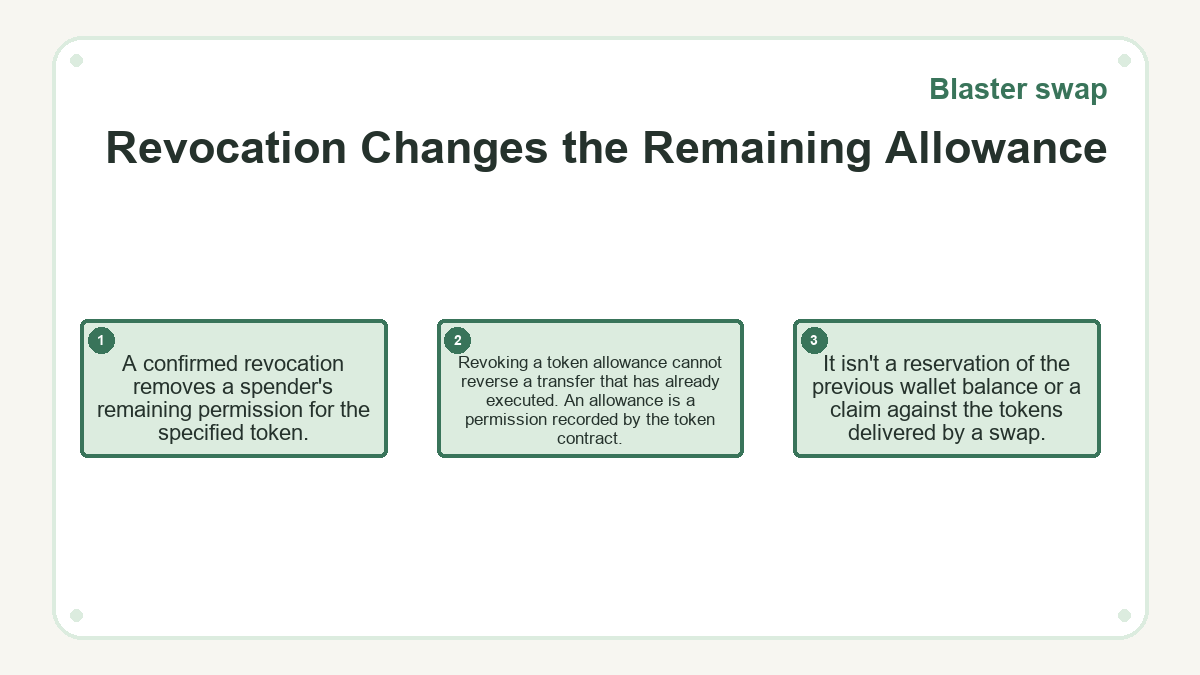
A confirmed revocation removes a spender's remaining permission for the specified token. Revoking a token allowance cannot reverse a transfer that has already executed. An allowance is a permission recorded by the token contract. It isn't a reservation of the previous wallet balance or a claim against the tokens delivered by a swap.
Separate Approval and Exchange Transactions
A separately confirmed approval can remain effective after an abandoned or failed exchange. The relevant check is the allowance for that owner, token and spender. A revocation must target that relationship; changing permission for another contract doesn't remove it.
Revocation During a Pending Swap
A revocation transaction submitted later from the same conventional account usually has a later nonce. It cannot overtake an earlier pending swap in that account's sequence. Even where a permission change executes first, the outcome depends on whether the exchange needs that permission. Revocation isn't a universal substitute for transaction replacement.
Failed Execution and Unchanged Swap Transfers
A fully reverted exchange transaction rolls back its execution changes, including token transfers made within that transaction. The network can still charge for computation already performed. Consequently, an unchanged input-token balance and a lower native-currency balance can describe a failed attempt rather than a partially completed exchange. Approval transactions that confirmed separately retain their own effects.
The receipt's failure status matters more than an interface message saying that something went wrong. A page can lose its connection after successful submission. Conversely, a wallet can reject an operation before it ever reaches the network. Those situations require different explanations, even when the screen presents a similar error.
Submitted Terms Cannot Be Edited in Place
A signed transaction commits to its encoded instructions, so changing a quote on screen doesn't rewrite the submitted exchange. The input, recipient and applicable execution limits belong to that signed request. Different terms require a different valid submission.
Where a swap method enforces an output threshold or deadline, those checks determine whether execution may proceed. They don't create a refund period afterward. A rejected transaction never completes the protected exchange; a successful transaction has satisfied the relevant contract checks. Neither outcome allows a later preference change to modify the original receipt.
An unsigned quote therefore remains the point for changing the intended exchange without competing against an existing submission. After submission, check the transaction's encoded instructions and execution status rather than relying on the quote currently displayed.
Restoring a Holding Requires a New Exchange
A completed swap leaves an execution record and resulting token balances; exchanging back creates another trade with separate execution terms. The original input amount isn't automatically recoverable. Pool liquidity, price movement and the fee that the pool charges can change the amount obtainable in the opposite direction.
Reconciliation should preserve both transactions rather than describing the second as deletion of the first. Compare the actual token movements, recipient and transaction costs. A refreshed portfolio valuation is a different measurement from token quantity, so a similar displayed value doesn't establish restoration of the original holding.
Any exchange back also requires an available execution path. Historical contract deployments alone don't demonstrate usable liquidity or a working interface today.
The Shutdown Window Applied to Position Withdrawals
Blaster swap's shutdown announcement asked users to withdraw liquidity or staking positions before January 15, 2025. It said the frontend would remain available until that date to facilitate withdrawals. That was an operational exit window for positions, not an opportunity to reverse historical token exchanges.
A website closing doesn't erase previously executed transactions. Historical receipts remain relevant to determining what happened, while any remaining position requires its own applicable withdrawal mechanism. The announced withdrawal date was January 15, 2025.
What readers ask about Blaster swap
Does Clearing Wallet Activity Cancel a Submitted Swap?
Clearing local wallet activity doesn't cancel a transaction already submitted to the network. It changes the wallet's local records, not the signed transaction held elsewhere. Keep the transaction hash before clearing anything, because losing that local entry can make it harder to distinguish a pending submission from a confirmed exchange.
What Happens If I Sign a Spending Permit but Never Submit the Swap?
A signed spending permit can remain usable even when you abandon the intended exchange. Its validity depends on the permit's contract rules, deadline and nonce. Where another party holds the signature, the absence of a swap receipt doesn't prove that authorization has disappeared. This applies only when the token and authorization mechanism support permits.
Is Rejecting a Wallet Prompt Charged Like a Failed Swap?
Rejecting an unsigned transaction prompt doesn't itself consume blockchain gas. A transaction that reaches execution and fails can consume gas, which is a different event. Earlier approvals or other submissions may already have incurred charges, so rejecting the latest prompt doesn't remove those separate costs.
Can I Correct the Recipient After a Swap Has Settled?
You can't edit the recipient recorded in a settled transaction. Returning assets requires another transfer by whoever can control them, or an applicable recovery mechanism if a contract received them. A wrong recipient doesn't create an automatic refund right or give the original sender authority over that address.
Will Signing the Exchange Again Replace the First Attempt?
Signing again doesn't necessarily replace the first attempt. A new conventional account transaction with a different nonce can execute in addition to the original. Before repeating an exchange, establish the earlier transaction's status and whether the wallet is explicitly constructing a replacement. Two similar-looking requests can produce two separate trades.
When a Transaction Disappears From an Explorer, Has Cancellation Succeeded?
A disappearing explorer entry alone doesn't prove successful cancellation. The explorer may have stopped tracking a pending transaction, or its data may be incomplete. For a conventional account transaction, stronger evidence is a confirmed replacement from the same sender using the original nonce, together with confirmation that the original swap didn't execute.
How Does Revoking an Allowance Affect Other Token Balances?
An ERC-20 allowance change applies to a particular token and spender. It doesn't revoke every permission associated with the wallet or restore unrelated balances. The same spender may have separate allowances for other tokens, while another spender may retain permission for the token whose approval you changed.